


OxyGuard Carbon Monoxide Detector
OxyGuard Carbon Monoxide Detector
Couldn't load pickup availability
Where Should I Put It?
Where Should I Put It?
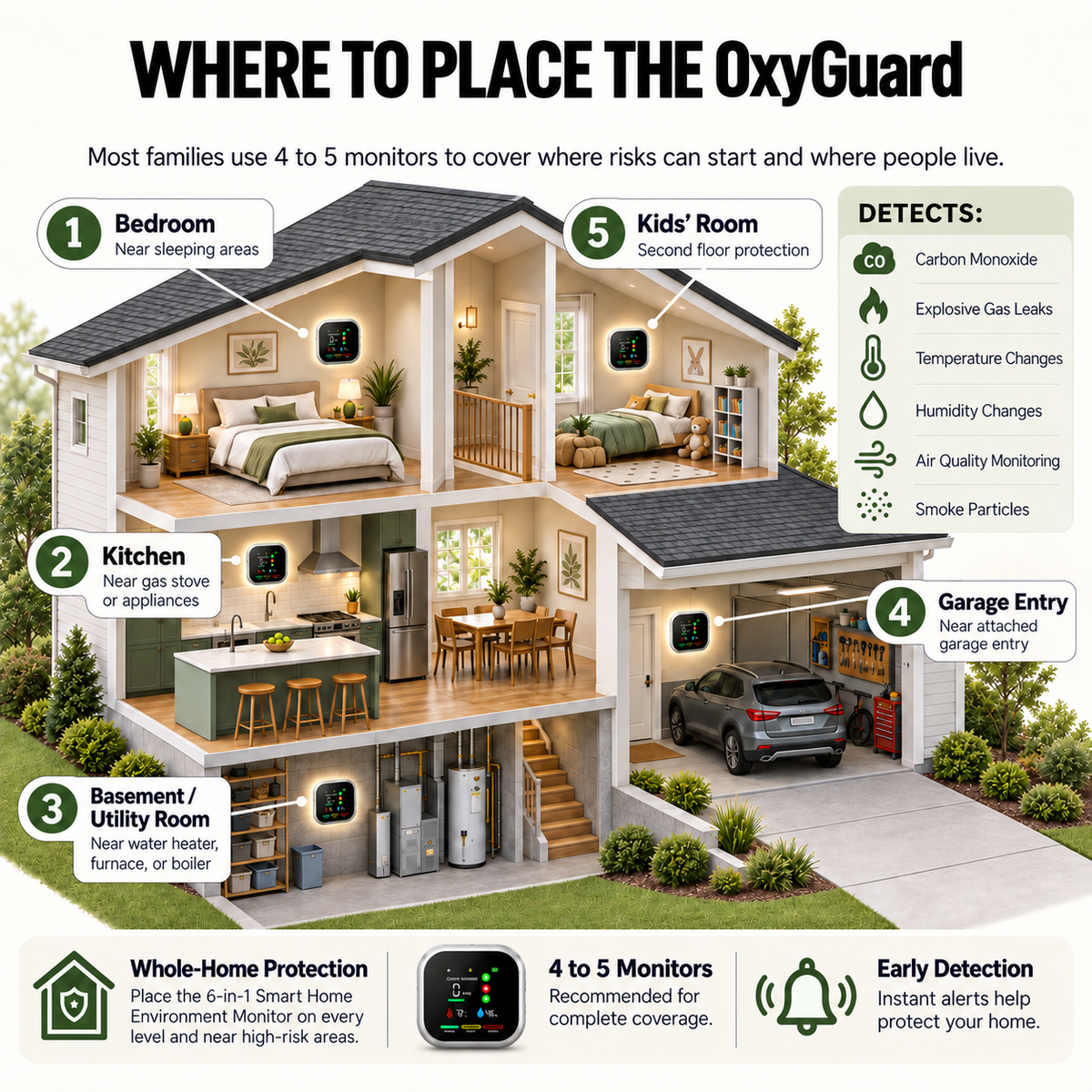
Start with the room your baby sleeps in. Then add one outside each sleeping area and one on every floor, especially near the furnace, water heater or an attached garage. Plug it into any outlet and you're protected.
How Will I Know It's Working?
How Will I Know It's Working?
You never have to guess. The screen shows a live CO reading 24 hours a day. Press the test button anytime to hear the alarm and confirm everything is on and watching.
90-Day Money Back Guarantee
90-Day Money Back Guarantee
You're fully covered by our 90-day money-back guarantee if you're not completely satisfied, send us an email and we'll refund you, no questions asked. There's truly zero risk in trying it.
We're confident OxyGuard will work for you, and we stand behind it completely.



The Danger Your Senses Don't Warn You About!
You check the baby monitor you lock the doors you wake at every cough at 3 AM. Your Doing all the right things. However, carbon monoxide gives you nothing to listen for. It leaks quietly into your home whether it's from furnace, a water heater, a car in the garage while everyone sleeps or something else.
Children and babies are affected first because they breathe faster than adults, so they take in CO faster, and they can't tell you when they feel dizzy, sick or sleepy.
The first warning sign should never be a sick child.

Your Procrastination Could Be Deadly
Most standard CO alarms only sound once levels are already high. Under the UL safety standard they're designed to stay silent until CO reaches 70 PPM for one to four hours. Your family can breathe low levels night after night, and the alarm says nothing.
OxyGuard works differently. Its sensor reads the air from 0 PPM and puts the number right on the screen, so you see a problem the moment it starts, not hours after.
Real numbers. Real early warning. Finally.

Join Over 55,000+ Parents Who Finally Sleep Through The Night
Thousands of parents have stopped lying awake wondering if the air in the nursery is safe. No more staring at a ceiling alarm with a blinking green light that tells them nothing. They plugged in OxyGuard, glanced at a steady 0 PPM before bed, and finally slept as soundly as their kids. Because when it comes to your family, a number you can see beats a beep you hope will come.
FAQ
How is OxyGuard different from the CO alarm I already have?
How is OxyGuard different from the CO alarm I already have?
A standard alarm stays silent until CO has built up for hours, and it only shows a green light until then. OxyGuard shows the actual CO level on its screen from 0 PPM, so you see a slow leak the day it starts, not after your family has been breathing it. OxyGuard is also louder than standard alarms.
Is it worth it if I already have smoke detectors?
Is it worth it if I already have smoke detectors?
Many homeowners choose OxyGuard as an additional layer of awareness because it combines multiple environmental monitoring features into one device. Its real-time display, temperature and humidity tracking, and multi-function design provide information that goes beyond a traditional alarm only detector, helping you stay more informed about your home's environment.
Where should I put it, and how many do I need?
Where should I put it, and how many do I need?
One in the nursery is the most important. For full coverage, add one outside each sleeping area and one on every floor, especially near the furnace, water heater or an attached garage. Most families with a baby choose 3 to 5 depending on home size.
Will it work if the power goes out?
Will it work if the power goes out?
Yes. The built-in rechargeable battery takes over automatically. That matters most in winter storms, when families run generators and space heaters, the exact moments CO risk is highest.
Will it go off when I cook?
Will it go off when I cook?
You may see the number tick up for a moment near a gas stove. That's normal, and many parents find it eye-opening. The loud alarm only sounds when CO reaches [70] PPM, so you get real warnings, not nuisance beeps.

What Safety Experts Want Every Parent To Know!
According to the CDC, more than 400 Americans die from accidental carbon monoxide poisoning every year, and over 100,000 end up in the ER.
The CDC lists infants among the people most at risk, and cases climb every fall and winter, when furnaces and space heaters run all night with the windows shut.
You can't see it. You can't smell it. With OxyGuard, you can.


